As a SaaS product grows, its architecture needs to support more customers, more data, more workflows, and stronger expectations around security and reliability. One of the most important early decisions is how to serve multiple customer organizations on a shared platform while keeping each customer's data and access appropriately separated.
This is the central challenge of multitenant SaaS architecture. The design affects infrastructure spending, deployment complexity, customer isolation, customization, maintenance, and the ability to scale. There is no single model that fits every SaaS business. The right choice depends on product requirements, risk, customer expectations, and the team's operational capabilities.
TheFinch Design's cloud application development services describe SaaS development with scalable cloud native solutions and multitenancy architecture, alongside cloud migration, infrastructure management, integrations, deployment, and support. This guide explains the main tenancy models, their trade offs, and the cost factors to consider before building or modernizing a SaaS platform.
What Is Multitenant SaaS Architecture?
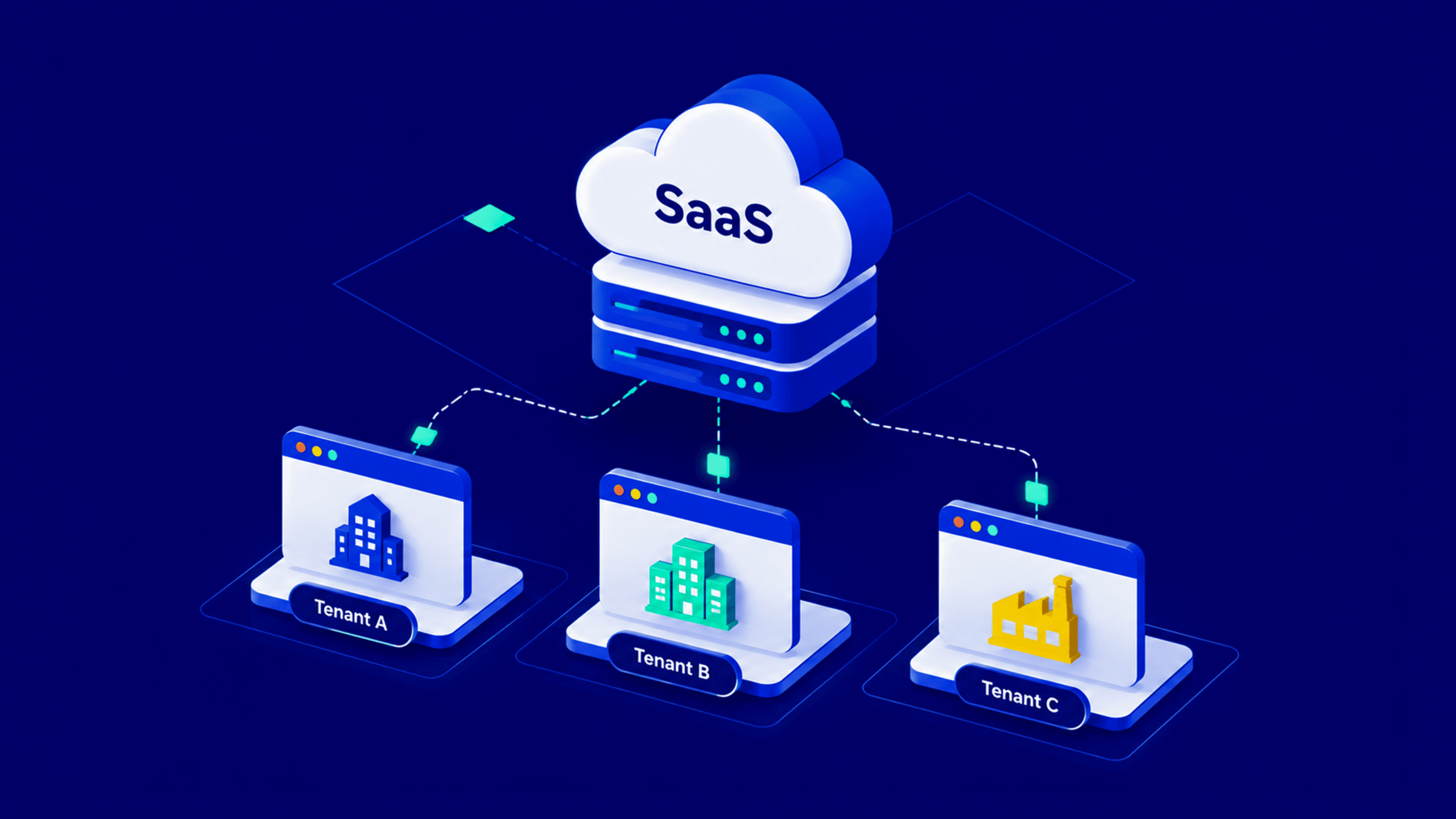
A multitenant SaaS application serves multiple customer organizations, often called tenants, from a shared application environment. Tenants may use the same application code and infrastructure, while the system separates their data and permissions according to the chosen architecture.
For example, a project management SaaS might serve hundreds of companies through one product. Each company can have its own users, projects, settings, and subscription, and users should only access information they are authorized to see. Tenant boundaries need to be enforced consistently across the database, APIs, files, background jobs, analytics, and administrative tools.
Multitenancy can improve operational efficiency because teams may maintain a common application rather than separate installations for every customer. However, shared infrastructure also means isolation, access control, monitoring, and incident response must be designed carefully.
The Main Multitenant Architecture Models
1. Shared Database and Shared Schema
In this model, multiple tenants share the same database and tables. Each tenant's records are associated with a tenant identifier, and application queries must enforce that boundary.
Advantages: This model can be cost efficient, easier to provision, and straightforward to operate at scale when designed well. Schema updates can be applied consistently across the tenant base.
Trade offs: A missed tenant filter or weak authorization check can expose data across customers. Large or uneven workloads may also affect other tenants, and customer specific data requirements can be harder to accommodate.
Best suited for: Many early stage SaaS products and standard subscription services where customers use a common feature set and tenant isolation can be robustly enforced.
2. Shared Database With Separate Schemas
Here, tenants share a database server but have separate schemas or equivalent logical namespaces. The separation can make tenant specific data easier to organize while retaining some shared infrastructure.
Advantages: Stronger logical separation than a single shared schema, with the potential for tenant level administration and selective data operations.
Trade offs: Schema provisioning, migrations, monitoring, and connection management become more complex as tenant numbers grow. Separate schemas do not automatically guarantee complete isolation if application permissions or database access are misconfigured.
Best suited for: Products that need more tenant level separation but still want to share database infrastructure.
3. Separate Database for Each Tenant
Each tenant receives its own database instance or database boundary, while the application code may remain shared.
Advantages: Greater data isolation, more flexibility for backup and restore, and the ability to tailor capacity or operational policies for particular customers.
Trade offs: Infrastructure and operational costs can rise. Database provisioning, monitoring, migrations, credentials, and version consistency require disciplined automation.
Best suited for: Enterprise customers, products with stricter isolation expectations, or businesses where tenant specific data operations are important.
4. Hybrid or Tiered Tenancy
A hybrid model combines approaches. Smaller customers may share a database and schema, while large or regulated customers receive separate schemas or databases. The application can still share code and common services.
Advantages: It allows the business to balance cost efficiency with differentiated customer requirements. Premium tiers may receive dedicated resources or stronger isolation.
Trade offs: The platform must support more than one deployment or data access pattern. Testing, observability, migration tooling, and support procedures become more demanding.
Best suited for: SaaS businesses serving a broad customer base with different pricing tiers, workload profiles, or contractual requirements.
Comparison: Which Model Should You Choose?
Model
Relative operating cost
Isolation potential
Main trade off
Shared DB + shared schema
Lower
Depends heavily on app controls
Efficient, but tenant filters must be correct
Shared DB + separate schemas
Medium
More logical separation
Schema operations become complex
Separate database per tenant
Higher
Strong database level separation
More provisioning and maintenance
Hybrid / tiered
Variable
Can vary by customer tier
More architectural paths to test and support
These are relative tendencies, not guarantees. Actual cost and isolation depend on database technology, deployment design, operational maturity, workload, and security controls.
Security and Tenant Isolation: What Must Be Designed In?
Tenant isolation is not just a database decision. It needs to be enforced at every layer where tenant data or actions can cross boundaries.
Authentication and authorization: verify both the user's identity and their permission to access the requested tenant and resource.
API boundaries: validate tenant context on every request, and do not trust a tenant ID supplied by the client without authorization checks.
Background jobs: carry tenant context through queues, scheduled tasks, exports, and notifications.
Files and object storage: use access controls and tenant aware paths or policies.
Observability: ensure logs, metrics, and support tools do not accidentally expose another tenant's sensitive data.
Testing: include cross tenant access tests, permission tests, and checks for common authorization failures.
Backup and deletion: understand how tenant level restore, retention, export, and deletion work in the selected model.
Security needs to be reviewed as the application evolves. New reporting features, admin tools, and integrations can introduce access paths that were not present in the original design.
How Multitenant Architecture Affects Cost
There is no universal price for implementing multitenancy. The total cost depends on the application's scale, data model, isolation requirements, cloud provider, reliability targets, and team experience. Consider these main cost categories:
Initial engineering A shared schema may be cheaper to launch, but it still needs careful tenant aware data modelling, authorization, and testing. Separate databases require additional provisioning and connection management. Hybrid systems often need more architecture and automation work.
Infrastructure and usage Shared resources can improve utilization, but noisy neighbour effects may require quotas, workload controls, or capacity upgrades. Dedicated tenant databases can increase fixed costs, particularly for many small customers.
Operations and deployment Every supported model needs backups, monitoring, migrations, incident response, and production support. Separate tenant environments increase the number of resources that must be monitored and updated. Automated infrastructure and repeatable migrations can reduce manual effort.
Security and compliance Additional isolation, audit logging, encryption, retention controls, and customer specific requirements may add development and operational costs. Requirements should be confirmed with qualified security and compliance professionals where necessary.
Future changes The cheapest launch architecture is not always the cheapest long term option. Consider how difficult it will be to add tenant specific settings, migrate a large customer, restore one tenant's data, or move a tenant to dedicated infrastructure later.
How to Choose the Right Model for Your SaaS
Start with customer requirements: identify isolation, data residency, customization, and contractual needs.
Understand workload patterns: estimate tenant count, data volume, traffic peaks, and whether a few customers may dominate usage.
Define operational capabilities: consider who will manage migrations, backups, monitoring, and incidents.
Plan the pricing model: decide whether dedicated resources are part of an enterprise tier or a paid option.
Design for evolution: document the reasons for the chosen model and keep a path open for moving selected tenants if requirements change.
Validate before scaling: test realistic data volumes, tenant boundaries, restore procedures, and failure scenarios.
TheFinch's cloud native applications, SaaS development, microservices, cloud infrastructure management, integration, and ongoing support are covered under its cloud application development offering. Its product design solutions also include SaaS dashboards and discovery led work that can help connect architecture decisions to actual user and business needs.
Common Mistakes to Avoid
Treating a tenant ID as sufficient security without enforcing authorization.
Choosing separate databases for every customer without planning automation and operational cost.
Assuming shared infrastructure automatically means lower total cost.
Ignoring background jobs, exports, analytics, and file storage when reviewing tenant boundaries.
Leaving migration, backup, restore, and tenant deletion strategies until after launch.
Overengineering for hypothetical scale instead of choosing an architecture that meets current needs and can evolve.
Conclusion: Choose an Architecture That Can Grow With the Product
Multitenant SaaS architecture is a balance between cost, isolation, operational complexity, flexibility, and scale. Shared schemas can suit products with standardized requirements and strong tenant aware controls. Separate schemas or databases can provide more separation at a higher operational cost. Hybrid models can support different customer tiers, but they require careful automation and testing.
The right choice begins with your customers, product requirements, risk profile, and operating model, not a technology trend. By considering tenancy early, SaaS teams can make informed decisions about security, infrastructure, and long term product growth.
TheFinch Design supports businesses with cloud application development and SaaS product design. If you are planning a new SaaS platform or rethinking the architecture of an existing product, explore TheFinch's cloud application development services or contact the team to discuss your requirements.
Frequently Asked Questions
What is multitenant SaaS architecture? It is an application architecture in which multiple customer organizations use a shared SaaS platform while the system enforces appropriate separation of their data, users, and permissions.
Which multitenant model is the cheapest? A shared database and shared schema often has lower infrastructure overhead, but total cost depends on security controls, workload, operational needs, and future requirements.
Is a separate database for every tenant more secure? It can provide stronger database level separation, but it does not replace application security, access controls, monitoring, and secure operations.
Can a SaaS product change its tenancy model later? Yes, but migration can be complex. Data movement, downtime, application changes, testing, and customer communication should be planned carefully.
What is a hybrid multitenant architecture? A hybrid model uses different tenancy approaches for different customers or tiers, for example, shared resources for smaller accounts and dedicated databases for enterprise customers.
What should be considered before choosing a model? Consider customer isolation needs, data sensitivity, workload, expected scale, pricing, operational capability, compliance requirements, and the ability to migrate or restore tenant data.
Ravi Talajiya
CEO of TheFinch
With over a decade of experience in digital design and business strategy, Ravi leads TheFinch with a vision to bridge creativity and purpose. His passion lies in helping brands scale through design thinking, innovation, and a deep understanding of user behavior.
Would you like to Listen?
Share this blog
Got the vision? We’ve got the expertise. Let’s create together.