Artificial intelligence is no longer an experimental addition to the design process. In 2026, AI is actively changing how digital products are researched, planned, designed, tested, and improved. From generating early concepts to analysing user behaviour, AI is helping design teams work faster and make more informed decisions.
However, the real transformation is not simply about automation. It is about creating smarter digital experiences that understand context, adapt to user needs, and reduce friction.
For businesses, this evolution has made choosing the right Design Agency more important than ever. Companies now need design partners that understand both human behaviour and emerging technology. A modern UI UX Design Agency must know how to use AI without losing the empathy, creativity, and strategic thinking that make a product valuable to real users.
So, how exactly is AI transforming UI/UX design in 2026? Let’s explore the most important changes.
1. AI Is Making UX Research Faster and More Actionable
User research has always been an essential part of successful product design. Interviews, surveys, usability tests, behavioural analysis, and customer feedback help designers understand what users need.
The challenge is that research can generate a massive amount of information.
AI is changing this process by helping UX teams analyse large volumes of qualitative and quantitative data more efficiently. Research notes, feedback, support queries, behavioural patterns, and usability observations can be organised into meaningful themes much faster.
For a User Experience Agency, this means designers can spend less time manually sorting information and more time understanding the reasons behind user behaviour.
AI can help identify:
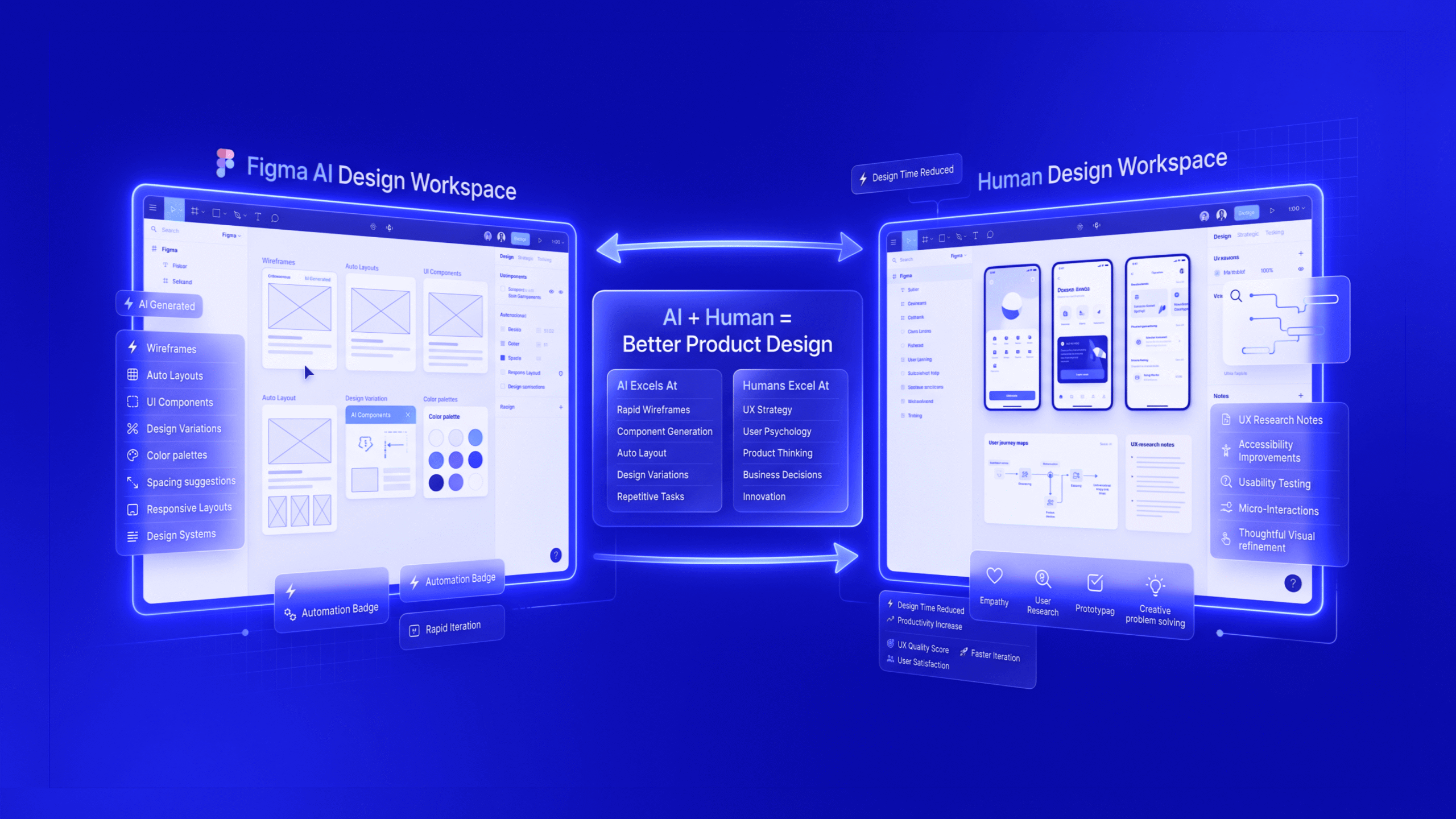
- Common usability problems
- Repeated customer complaints
- Behavioural patterns
- User intent
- Friction in customer journeys
- Potential opportunities for product improvement
But AI does not replace UX researchers. Human expertise remains essential for understanding emotional context, cultural differences, business objectives, and complex user motivations.
The strongest UX process in 2026 combines AI-assisted analysis with human interpretation.
2. Personalised User Experiences Are Becoming More Intelligent
Traditional interfaces often present the same experience to every user. AI-powered products are moving beyond this static model.
In 2026, digital experiences are becoming increasingly adaptive.
An interface may adjust recommendations, content, navigation priorities, or workflows based on user behaviour and context. This allows businesses to create experiences that feel more relevant instead of forcing every user through an identical journey.
For example, a SaaS platform may highlight different dashboard features for a new user and an experienced administrator. An e-commerce platform may reorganise recommendations based on browsing behaviour. A financial application may simplify information depending on a user's experience level.
A strategic UX Agency considers how personalisation affects the complete customer journey. The goal is not to change the interface simply because AI makes it possible. Every adaptive element should improve clarity, usability, or task completion.
Good personalisation feels helpful.
Poor personalisation feels unpredictable.
That distinction is becoming a critical responsibility for UI/UX designers.
3. Generative AI Is Accelerating Design Exploration
One of the most visible changes in the design industry is the growth of generative AI.
Designers can now explore concepts, layouts, content structures, user flows, and visual directions at greater speed. Instead of spending hours creating multiple early-stage variations manually, AI can support rapid ideation.
This is particularly valuable during the early stages of Product design.
Design teams can use AI to explore:
- Alternative page structures
- Dashboard concepts
- Content hierarchy
- User flow possibilities
- UX writing variations
- Design directions
- Early interface concepts
However, generating more options does not automatically create a better product.
Experienced designers still need to evaluate whether a concept aligns with user expectations, accessibility requirements, brand identity, and business goals.
At TheFinch Design, our approach to UI/UX Design focuses on human-centric digital experiences. AI can accelerate exploration, but strategic design decisions must remain connected to the people who will actually use the product.
4. UI Design Is Moving From Static to Context-Aware
The role of a User Interface Design Company is changing.
Previously, interface design primarily focused on visual hierarchy, layout, typography, colours, interactions, and responsive behaviour. These principles remain important, but AI-powered products introduce a new challenge: context.
Modern interfaces may need to respond to changing data, user intent, or AI-generated outcomes.
Consider an AI assistant.
The interface cannot always predict the exact length, format, or nature of an AI-generated response. Designers must create flexible systems that can support unexpected outputs while maintaining clarity.
This requires designers to think beyond static screens.
They must design states, behaviours, feedback systems, error scenarios, loading experiences, and user controls.
In 2026, excellent UI design is not only about how an interface looks.
It is about how intelligently the interface communicates what the system is doing.
5. AI Prototyping Is Shortening the Path From Idea to Validation
Prototyping is an important part of the UX design process because it allows teams to test ideas before investing heavily in development.
AI is making this stage significantly faster.
Designers can create early concepts, draft user flows, develop interface variations, and explore interaction ideas with greater efficiency. This allows teams to move into validation earlier.
For startups and enterprises, faster prototyping can reduce costly assumptions.
A professional UI UX Design Firm can use AI-assisted workflows to evaluate multiple design directions while maintaining a structured design process.
The real advantage is not simply speed.
It is the ability to learn faster.
When teams can test an idea earlier, they can identify usability problems before those problems become expensive development issues.
Businesses exploring a new digital product can also begin with Design Discovery to establish user needs, product requirements, and strategic direction before moving into detailed design.
6. UX Writing Is Becoming More Contextual
Microcopy plays an important role in digital experiences.
Button labels, error messages, onboarding instructions, tooltips, notifications, and empty states influence how easily users understand a product.
AI can help design teams generate and evaluate multiple content variations quickly. More importantly, AI-powered systems are enabling contextual communication.
Instead of showing a generic error message, a product may provide information based on the user's action or current workflow.
But clarity must remain the priority.
AI-generated copy can sound unnatural, overly complicated, or inconsistent with a brand's personality if it is not reviewed carefully.
A skilled User Experience Agency ensures that AI-assisted UX writing remains:
Clear, concise, consistent, accessible, and aligned with user intent.
The future of UX writing is not about producing more words.
It is about providing the right information at the right moment.
7. AI Is Improving Usability Testing and Design Evaluation
Usability testing helps teams identify where users struggle with a digital product.
In 2026, AI is supporting designers by helping analyse behavioural patterns and identify potential friction points. Teams can review user interactions, repeated navigation problems, task completion patterns, and feedback more efficiently.
This can be particularly useful when combined with a professional UX Design Audit.
AI-assisted analysis may highlight potential issues, but experienced UX professionals must determine why the problem exists and how it should be solved.
For example, a high drop-off rate may indicate:
- Confusing navigation
- Poor information hierarchy
- Unclear content
- Too many steps
- Lack of trust
- Technical performance issues
Data identifies the symptom.
UX expertise helps diagnose the problem.
That is why AI and human design judgement work best together.
8. Designing AI Products Requires New UX Principles
AI products introduce unique design challenges.
Users may not understand how an AI system works. They may be uncertain about the accuracy of an answer or confused about why a recommendation was made.
This makes transparency an important part of AI UX.
A modern UI UX Agency must consider questions such as:
Can users understand what the AI is doing?
Does the interface communicate uncertainty?
Can users correct an AI-generated result?
Is there a clear way to provide feedback?
Does the user feel in control?
These questions are becoming essential for AI, SaaS, fintech, healthcare, and enterprise products.
The best AI interface should not make technology feel more complicated.
It should make sophisticated technology easier to understand and use.
9. Design Systems Are Becoming More Dynamic
Design systems traditionally provide reusable components, visual standards, typography rules, spacing guidelines, and interaction patterns.
AI is making design systems more intelligent and scalable.
Teams can use AI-supported workflows to identify inconsistencies, document components, explore variations, and improve collaboration between designers and developers.
For growing digital products, a strong Design System creates consistency across platforms and teams.
However, AI also creates a new requirement.
Design systems must be flexible enough to support dynamic and unpredictable content.
An AI-generated answer may be one sentence or several paragraphs. A recommendation component may contain different types of information. An intelligent dashboard may prioritise data differently for different users.
Design systems in 2026 must support this flexibility without sacrificing consistency.
10. AI Is Changing the Role of UI/UX Designers
One of the biggest questions in the design industry is whether AI will replace designers.
The more realistic change is that AI is transforming what designers spend their time doing.
Repetitive tasks can increasingly be accelerated. Early concepts can be explored faster. Research information can be organised more efficiently.
This gives designers more opportunities to focus on strategic questions.
What problem are we solving?
Why are users struggling?
What should the product prioritise?
How can we simplify complexity?
Does the experience build trust?
A future-ready Design Agency will not compete with AI by avoiding it. It will use AI thoughtfully while strengthening human skills such as empathy, critical thinking, storytelling, collaboration, and strategic decision-making.
Human-Centred Design Still Matters More Than Ever
AI can analyse patterns.
It can generate ideas.
It can accelerate workflows.
But AI does not experience frustration when a checkout process fails. It does not feel uncertainty when a financial dashboard is confusing. It does not understand trust in the same way a human user experiences it.
This is why human-centred design remains essential.
Businesses need a UI UX Design Agency that understands when to use AI and when human judgement must lead the process.
The future of design is not AI versus designers.
It is AI-supported designers creating better experiences for humans.
How TheFinch Design Approaches AI-Led UI/UX Design
At TheFinch Design, we believe emerging technology should make digital experiences more intuitive, not more complicated.
As an AI-led UI UX Design Firm, our focus is on combining strategic thinking, user research, creativity, and modern design workflows to build experiences that solve real problems.
Whether it is an AI platform, SaaS product, enterprise application, mobile experience, or digital ecosystem, we approach Product design with one important question:
How can we make this experience clearer, easier, and more valuable for the user?
Our UI/UX Consulting Services help businesses turn complex product challenges into structured and user-focused digital experiences.
Conclusion
AI is transforming UI/UX design in 2026 by accelerating research, improving personalisation, supporting rapid prototyping, enabling contextual interfaces, and changing how digital products communicate with users.
But technology alone does not create an exceptional experience.
Successful products still require empathy, strategic thinking, usability, accessibility, and a deep understanding of human behaviour.
The businesses that succeed will be those that combine the intelligence of AI with the creativity and judgement of experienced design teams.
Looking for a UX Agency or User Experience Agency that understands AI-led digital products?
Partner with TheFinch Design to create intuitive, scalable, and conversion-focused digital experiences built for the future.
Let’s discuss your product idea and transform complex technology into an experience your users can understand, trust, and enjoy.
Ravi Talajiya
CEO of TheFinch
With over a decade of experience in digital design and business strategy, Ravi leads TheFinch with a vision to bridge creativity and purpose. His passion lies in helping brands scale through design thinking, innovation, and a deep understanding of user behavior.