UI/UX Agency vs In-House Designer vs Freelancer: What’s Right for Your Stage of Growth?
UI/UX Agency vs In-House Designer vs Freelancer: What’s Right for Your Stage of Growth?
UI/UX/Marketing/
23 Oct, 2026
Table of contents
Introduction
For a SaaS business, design is not simply about making screens look polished. It shapes how quickly users understand a product, how confidently they complete key tasks, and how easily a team can introduce new features as the business grows. Yet one important decision often arrives before the design work itself: should you partner with a UI/UX design agency, hire an in-house designer, or work with a freelancer?
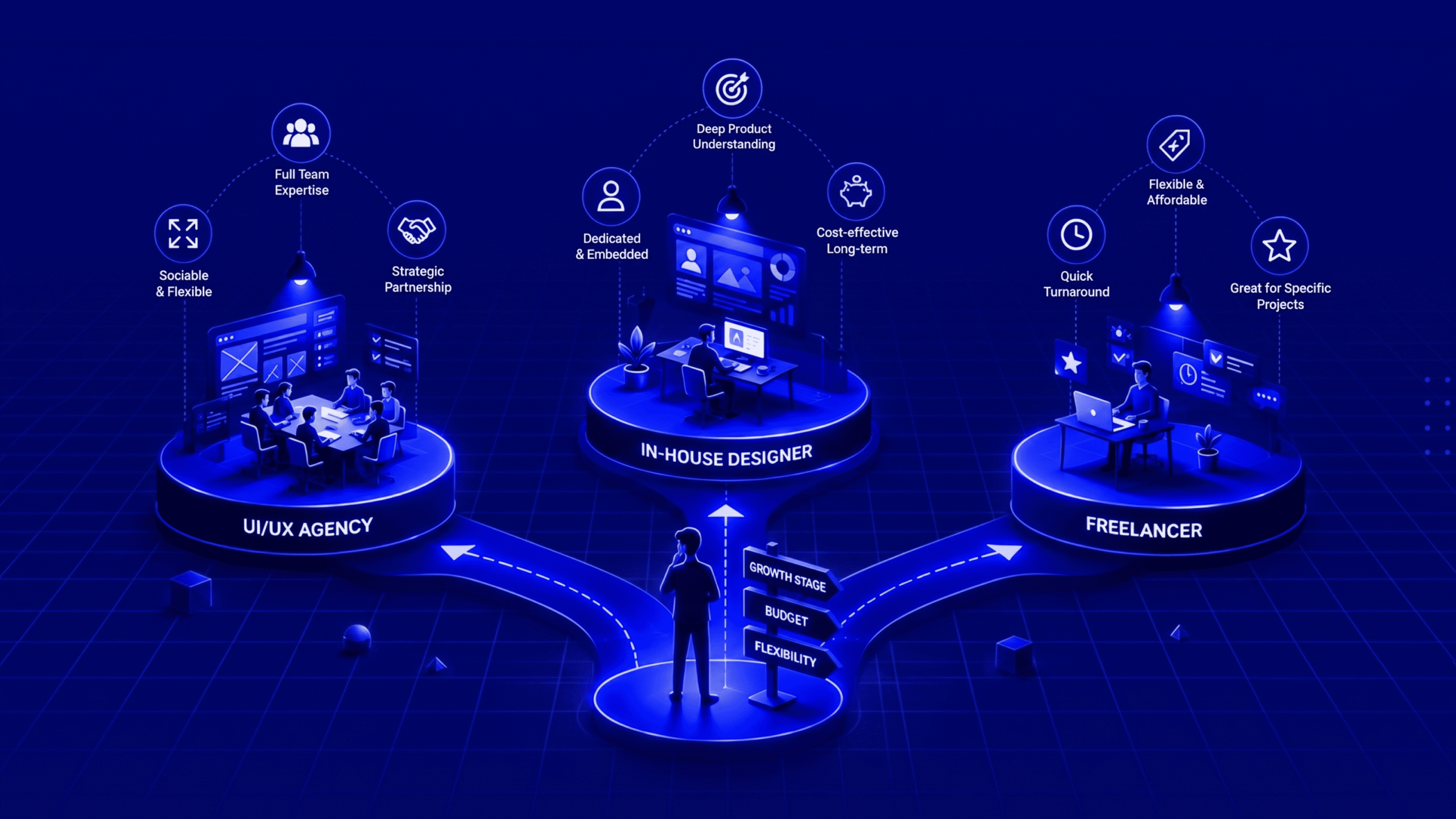
There is no universal winner. Each model offers a different balance of cost, speed, specialist expertise, collaboration, and long-term continuity. The right choice depends on your product stage, roadmap, budget, internal capabilities, and how much design work you expect over time. This guide to “UI UX agency vs in-house designer vs freelancer” explains the trade-offs and shows how SaaS teams can make a practical decision without overcommitting resources.
1. UI/UX Agency: A Cross-Functional Partner for Complex Needs
A UI/UX agency is often a strong fit when a SaaS product needs more than isolated screen design. Depending on the engagement, an agency can bring together UX strategy, user research, information architecture, wireframing, interface design, prototyping, usability testing, and design-system thinking. That breadth can be valuable when a product is moving from an MVP to a more mature platform or preparing for a significant redesign.
For SaaS teams, this can mean mapping complicated workflows, improving onboarding, clarifying dashboard information, or creating consistent patterns across multiple modules. TheFinch Design’s SaaS design services cover research and strategy, user flows, wireframes and prototypes, UI/UX, onboarding, dashboards, data visualisation, and design systems.
The main advantages are access to varied expertise, a structured process, and the ability to scale support around a defined project or ongoing roadmap. An agency can also bring an outside perspective when internal teams are too close to the product to spot usability problems. The trade-offs are that the engagement needs clear scope, stakeholder access, and regular feedback. Costs may be higher than hiring a single freelancer for a narrowly defined task, and the team will need to align on communication and decision-making.
Best suited for
SaaS startups validating a product direction, growing teams redesigning core workflows, businesses building a design system, and organisations that need several design capabilities without hiring every specialist full-time.
2. In-House Designer: Deep Product Context and Daily Collaboration
An in-house designer works within your company and can build a close understanding of the product, users, engineering constraints, business priorities, and internal decision-making. This continuity is particularly useful when design work is ongoing and closely tied to weekly product releases.
In-house designers can join planning sessions, respond to emerging feedback, collaborate directly with developers, and refine features over multiple iterations. Over time, they may become a trusted source of product knowledge and help establish design standards across teams. They can also support a shared design culture, provided leadership gives design a meaningful role in product decisions.
The trade-off is the breadth of expertise available from one person. A single designer may be excellent at product UI but have limited time for user research, accessibility reviews, design-system governance, marketing pages, and complex prototyping simultaneously. Hiring also involves recruitment, onboarding, salary, benefits, management, and the risk of a skills gap if the roadmap changes. A growing SaaS company may eventually need multiple designers or specialist external support.
Best suited for
SaaS companies with a steady flow of design work, a clear product direction, frequent collaboration with engineering, and enough recurring demand to justify a permanent role.
3. Freelancer: Flexible Expertise for Clearly Defined Work
A freelancer can be a practical choice when you need help with a specific deliverable: designing a landing page, refreshing a small set of screens, creating a prototype, or resolving a defined UX problem. Freelancers may offer specialist skills and can often start quickly, depending on availability and project scope.
This model can keep commitments flexible and is useful when a startup is testing an idea before building a permanent design function. A focused brief, agreed milestones, and clear acceptance criteria help both sides work efficiently.
However, a freelancer is one individual with finite capacity. They may not be able to cover research, UX strategy, visual design, testing, and ongoing iteration at the same depth. Availability can change, and continuity may become difficult if the project expands or requires frequent support. The business must also manage handoff, documentation, feedback, and coordination with developers. Before engaging a freelancer, confirm ownership of source files, design components, deliverables, and any relevant confidentiality terms.
Best suited for
Early-stage founders with a narrow scope, teams that need a short-term specialist, or businesses with occasional design requirements and an internal person able to manage delivery.
4. Compare the Three Models
Factor
UI/UX agency
In-house designer
Freelancer
Expertise
Can combine multiple specialties
Depends on one hire’s skill set
Usually strongest in selected skills
Product context
Builds context through collaboration
Deepens over time
Depends on project duration and access
Flexibility
Can scale by engagement or scope
Best for ongoing internal demand
Often flexible for defined tasks
Continuity
Good with a clear partnership model
High day-to-day continuity
Varies with availability
Management effort
Shared process, but needs alignment
Internal leadership and prioritisation
Client manages coordination and handoff
Typical fit
Complex or multi-disciplinary work
Continuous product roadmap
Focused, limited deliverables
5. Choose Based on Your Stage of SaaS Growth
Idea stage or MVP
At this point, speed of learning matters more than building a large design operation. A freelancer can help with a tightly scoped prototype or interface. An agency may be the better choice if you need product discovery, user flows, research, and validation before committing to development. Keep the first scope focused on the riskiest assumptions.
Early traction and product-market learning
As real users arrive, you need to understand where they struggle and which improvements matter most. A flexible agency engagement can provide research and design support across several areas, while a freelancer can handle a defined backlog. If design work is becoming continuous and deeply embedded in sprint planning, consider bringing an in-house designer into the team.
Scaling product and teams
When features, user segments, and engineering capacity expand, consistency becomes more important. An in-house designer can maintain product context, while an agency can support design-system development, complex workflows, or major redesigns. Some teams use a hybrid model: internal ownership for everyday decisions and external specialists for high-impact projects.
Enterprise complexity or redesign
If the product includes role-based permissions, data-heavy dashboards, integrations, or multiple user journeys, evaluate the full problem rather than simply counting screens. Research, information architecture, usability testing, and implementation handoff may all be necessary. A structured UX research process can help uncover the root causes of friction before the team invests in a visual refresh.
6. Questions to Ask Before You Decide
How much design work will we need each month, and is the demand predictable?
Does the challenge require one specialist or several complementary skills?
Will design decisions change frequently as we learn from users?
Who will own priorities, review work, and make final product decisions?
What documentation and handoff will developers need to implement the design?
How will we measure success—task completion, activation, retention, conversion, or reduced support requests?
These questions help turn the choice from a debate about job titles into a decision about outcomes, capacity, and operating model.
7. Consider a Hybrid Model as You Grow
The choice does not have to remain fixed. A company might begin with a freelancer for an MVP, bring in an agency for discovery and a core redesign, and hire an in-house designer when the roadmap creates sustained demand. Another team may keep product strategy internal while using external partners for research, design systems, or a new product line.
For hybrid arrangements to work, define ownership clearly. Decide who sets priorities, who approves design decisions, how files and components are documented, and how external contributors collaborate with engineering. A shared design system can reduce inconsistencies and make future work easier to maintain. Learn more about design system services if your product needs reusable components and clearer design governance.
Conclusion
When weighing UI UX agency vs in-house designer vs freelancer, choose the model that matches the work you need now—not the structure you assume you will need forever. Agencies are useful for multi-disciplinary challenges and structured projects; in-house designers provide continuity and deep product knowledge; freelancers offer flexibility for well-defined tasks. Each can deliver value when expectations, responsibilities, and success measures are clear.
For SaaS businesses, the most effective design approach is the one that helps users complete meaningful tasks while supporting a product roadmap the team can sustain. TheFinch Design partners with SaaS teams on research, user journeys, dashboards, onboarding, interface design, and design systems. Explore our SaaS UI/UX design services to discuss the right design support for your current stage of growth.
Frequently Asked Questions
Is a UI/UX agency better than an in-house designer?
Not in every situation. An agency can offer a broader mix of skills for complex projects, while an in-house designer provides day-to-day continuity. The better choice depends on the scope, cadence, and internal capabilities.
Is hiring a freelancer cheaper?
A freelancer may cost less for a narrowly defined task, but total cost also depends on project management, revisions, availability, and the expertise required. Compare deliverables and outcomes, not only hourly or project rates.
When should a SaaS startup hire an in-house designer?
Consider a full-time hire when design work is recurring, closely connected to product sprints, and substantial enough to keep the role focused on meaningful priorities.
Can a SaaS company combine an agency and an in-house designer?
Yes. An in-house designer can own everyday product context while an agency adds specialist capacity for research, design systems, major feature work, or redesigns. Clear ownership and handoff processes are essential.
marketing
Would you like to Listen?
Share this blog
Got the vision? We’ve got the expertise. Let’s create together.