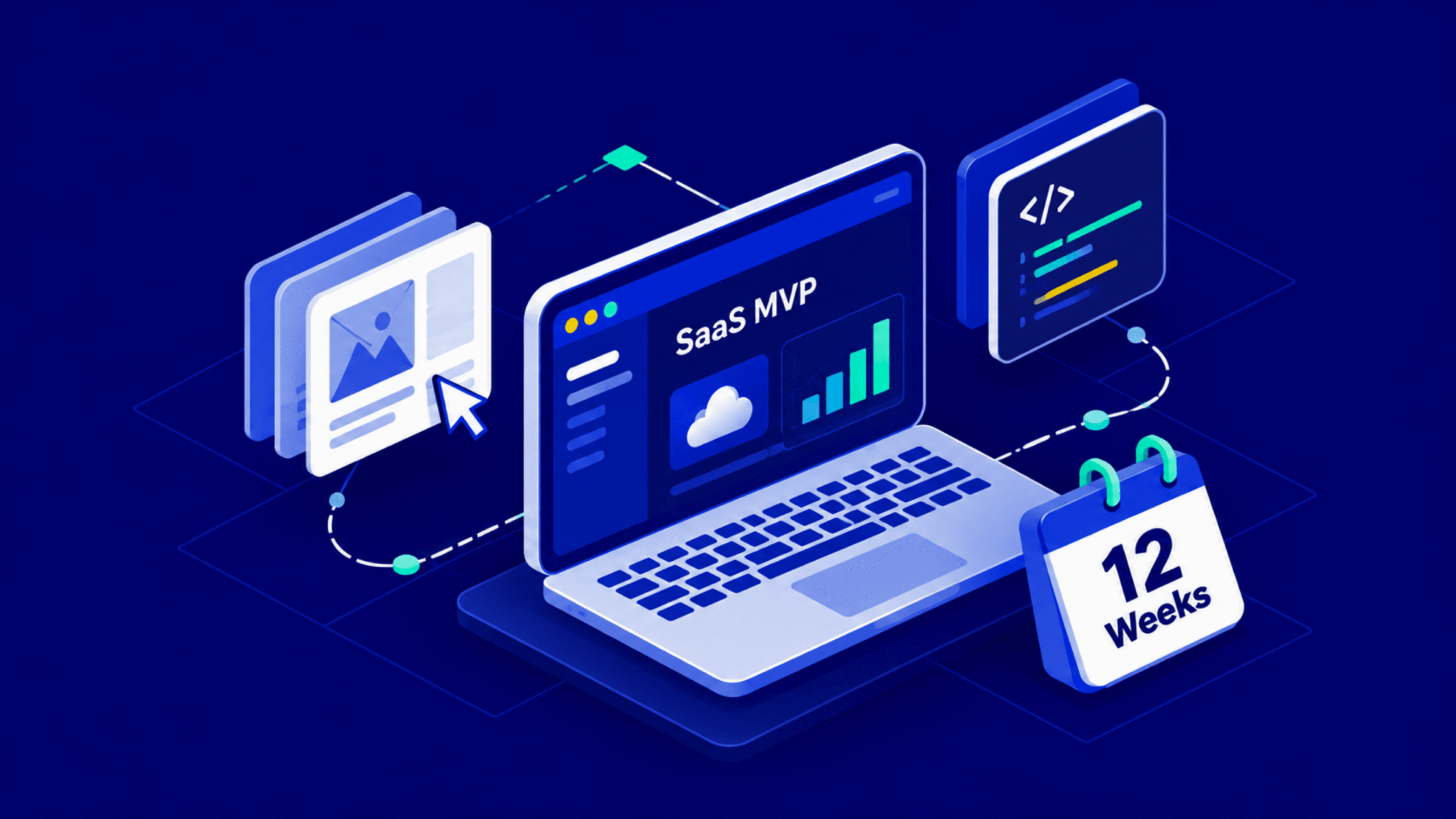
Building a SaaS product can feel like a race to deliver features, but the strongest first releases start with a clear problem, a focused scope, and a plan to learn from real users. A minimum viable product (MVP) is not a rushed or unfinished version of a larger platform. It is the smallest useful product that lets a team test its most important assumptions and learn whether the solution creates value.
A well planned SaaS MVP development process brings product strategy, UX/UI design, engineering, testing, and launch preparation into one coordinated roadmap. Twelve weeks can be a practical target for a focused MVP when decisions are made quickly, stakeholders stay available, and the product does not require unusually complex integrations or compliance work. It is a planning framework, not a universal guarantee.
TheFinch Design's MVP design services focus on defining core features, validating product ideas, gathering feedback, and creating user centred experiences. Its broader SaaS product design practice addresses user flows, dashboards, prototypes, and design systems. These principles provide a useful foundation for planning an MVP from idea to launch.
What Should a SaaS MVP Include?
Before setting a timeline, define the main problem your product solves and the single core outcome a user should be able to achieve. For example, a project management MVP might let a team create a project, assign tasks, and track progress. A reporting product might connect one data source and deliver a useful dashboard. The first release should demonstrate the product's central value without trying to serve every possible use case.
A typical SaaS MVP may include:
- A focused signup and login flow.
- One primary user journey that solves the core problem.
- Only the essential dashboard, workflow, or reporting features.
- Basic account settings and appropriate user permissions.
- Required integrations and secure data handling.
- Product analytics, error monitoring, and a feedback channel.
Features such as advanced automation, extensive customization, multiple third party integrations, and complex reporting can often be prioritized for later releases unless they are essential to the product's value proposition.
The 12 Week SaaS MVP Development Roadmap
Weeks 1 to 2: Discovery, Research, and Product Scope
Begin with discovery rather than code. Interview stakeholders and, where possible, prospective users to understand the problem, existing workarounds, buying context, and what success would look like. Review competitors and identify how your product can offer a distinct benefit.
Translate the findings into a product brief, primary user persona or segment, core user journey, prioritized feature list, and measurable launch goals. Separate must have features from later enhancements. TheFinch's design discovery process emphasizes business goals, user needs, market research, competitor analysis, and roadmapping, which are activities that help reduce ambiguity before design and development.
Deliverables: product brief, target user definition, MVP scope, prioritized backlog, success metrics, and initial technical assumptions.
Weeks 3 to 4: UX Design, Wireframes, and Prototyping
Map the core user journey from first visit or signup to the moment the user receives value. Create wireframes to define layout and information hierarchy before investing in detailed visual design. Pay particular attention to onboarding, empty states, form validation, navigation, and error recovery.
Build a clickable prototype and test it with representative users or stakeholders. The goal is to find confusing steps and validate the flow before engineering begins. For a SaaS product, clear dashboards and role specific experiences matter because users may need to interpret data and complete tasks repeatedly.
TheFinch's SaaS design services cover user research, user flows, prototypes, interface design, and design systems. A reusable set of components can also make implementation more consistent and future updates easier.
Deliverables: user flows, wireframes, interactive prototype, initial UI system, and prioritized usability feedback.
Weeks 5 to 6: Visual Design and Technical Foundation
Finalize the interface for the MVP's essential screens, including loading, empty, success, and error states. Document component behaviour and responsive layouts so developers understand how the experience should work across supported screen sizes.
In parallel, the engineering team can confirm architecture, data model, authentication approach, hosting, API structure, environments, and deployment workflow. Make security and privacy requirements explicit from the beginning. Avoid introducing complex infrastructure before the product actually needs it, but do not compromise on essential safeguards.
Deliverables: approved UI designs, design specifications, architecture decisions, development environments, and an implementation plan.
Weeks 7 to 9: Core Product Development
Build the most important end to end workflow first. Depending on the product, this may include account creation, the main dashboard, creating or managing a record, collaboration, reporting, or a core transaction. Connect the interface to backend services and required integrations as the workflow takes shape.
Use short development cycles with regular demonstrations. Product owners should review progress frequently and resolve questions quickly. Keep the backlog focused: adding a new feature during this stage should require a clear reason and an explicit decision about what it displaces.
Engineering should include code review, basic automated tests, access control checks, error handling, and monitoring setup throughout the build, not only at the end.
Deliverables: working core workflows, connected frontend and backend, essential integrations, and incremental test results.
Weeks 10 to 11: QA, Usability Testing, and Refinement
Test the MVP against the agreed acceptance criteria. Cover key user journeys, account permissions, validation, failure scenarios, supported browsers, responsive behaviour, and integration errors. Check performance and review security sensitive flows, including authentication and data access.
Run usability sessions with representative users when feasible. Watch whether people can complete the core task without explanation, where they hesitate, and what they expect to happen next. Fix high impact issues before adding optional features.
TheFinch's broader product design approach includes prototyping, testing, iteration, and post launch evaluation. These activities help teams validate that a product is not only functional but understandable and usable.
Deliverables: prioritized bug list, usability findings, fixes for critical issues, release checklist, and a go or no go decision.
Week 12: Launch Preparation and Release
Prepare the production environment, backups, analytics events, error monitoring, support process, onboarding content, and release communications. Confirm that the team knows how to identify incidents and roll back a problematic release if needed.
Launch to a controlled group if possible. Monitor activation, task completion, errors, support requests, and early user feedback. A successful launch is not simply a live URL. It is the start of a structured learning cycle.
Deliverables: production release, onboarding guidance, analytics dashboard, support ownership, and a prioritized post launch roadmap.
How to Keep a 12 Week Timeline Realistic
- Keep the first release focused on one primary user problem and one clear outcome.
- Assign a decision maker who can resolve scope questions quickly.
- Make user access and stakeholder feedback available early.
- Confirm integrations and technical dependencies during discovery.
- Use short iterations and review working software frequently.
- Define acceptance criteria and protect time for QA.
- Treat the schedule as a planning target, because complex products may need more time.
Common SaaS MVP Mistakes to Avoid
The most common mistake is treating an MVP as a smaller version of every planned feature. This spreads time and budget across too many workflows and can leave the core experience incomplete. Another mistake is skipping research and assuming that internal opinions represent user needs.
Teams can also underestimate integrations, access permissions, data migration, and testing. Finally, launching without analytics or a feedback process makes it difficult to know what users value. Keep the first release narrow, but build it carefully enough to learn from real use.
What to Measure After Launch
Choose a small set of metrics tied to the product's purpose. Useful measures may include:
- Activation: the share of new users who reach the first meaningful outcome.
- Time to value: how long it takes users to complete the core task.
- Task success: whether users can finish the main workflow.
- Retention: whether users return and continue receiving value.
- Reliability: errors, crashes, failed requests, or downtime.
- Feedback: recurring user requests, support issues, and usability barriers.
Use the findings to decide what to improve next. Prioritize issues that block core tasks before expanding the feature set.
Conclusion: Build to Learn, Then Scale
A 12 week SaaS MVP plan works best when discovery, design, development, testing, and launch are treated as connected stages rather than separate handoffs. The key is to define a clear user problem, design the shortest useful journey, build the essential functionality, validate it with users, and measure what happens after release.
TheFinch Design helps businesses shape focused, user centred digital products through MVP design, SaaS UX/UI, prototyping, and product strategy. If you are planning a new SaaS product, explore TheFinch's MVP design services to discuss how to turn your idea into a clear, testable product experience.
Frequently Asked Questions
Can a SaaS MVP really be built in 12 weeks?
A focused MVP can sometimes be designed and developed in 12 weeks if the scope is controlled, decisions are timely, and technical requirements are manageable. Complex integrations, regulated data, or advanced workflows can require a longer timeline.
What is the first step in SaaS MVP development?
Start with discovery: define the user problem, target audience, business objective, core workflow, and success metrics before prioritizing features.
Should design be completed before development starts?
Core flows and key interface decisions should be validated early. Design and development can overlap after the team agrees on the main journey and works from clear specifications.
What features should be included in a SaaS MVP?
Include the minimum features needed for users to achieve the product's main outcome, along with essential authentication, data handling, permissions, monitoring, and feedback mechanisms.
How do you measure SaaS MVP success?
Track whether users reach the core outcome, complete key tasks, return to the product, and provide useful feedback. Combine behavioural metrics with qualitative research.
What happens after the MVP launch?
Review analytics and user feedback, fix high impact usability or reliability issues, and prioritize the next release based on evidence rather than assumptions.
Ravi Talajiya
CEO of TheFinch
With over a decade of experience in digital design and business strategy, Ravi leads TheFinch with a vision to bridge creativity and purpose. His passion lies in helping brands scale through design thinking, innovation, and a deep understanding of user behavior.