15+ Best AI Tools for UI UX Designers to Explore in 2026
15+ Best AI Tools for UI UX Designers to Explore in 2026
AI Technology/Ravi Talajiya/
18 Feb, 2025
Table of contents
AI has changed the way UI/UX designers work. Not because it can magically replace designers, but because it removes a lot of the slow, repetitive work that usually sits around the real design thinking.
As a UI/UX designer, I do not use AI to “finish” design for me. I use it to start faster, explore more directions, summarize research, clean up copy, write better UX microcopy, prepare presentations, create first drafts, and sometimes turn a rough idea into something I can quickly discuss with a client or development team.
The important part is knowing which AI tool to use for which job.
Some tools are useful for prototyping. Some are better for UX research. Some help with visuals. Some are useful for content, design documentation, user flows, product thinking or design-to-code experiments.
This guide covers the AI tools that are actually useful for UI/UX designers in 2026, what each tool does, how it helps in the design workflow, and how much it costs as of 10 July 2026.
Pricing note: AI tool pricing changes often, especially because many tools now use credits or usage-based billing. The prices below were checked from official pricing pages or help pages where available at the time of writing.
List of Powerful AI tools for UI UX Designers
1. Figma AI
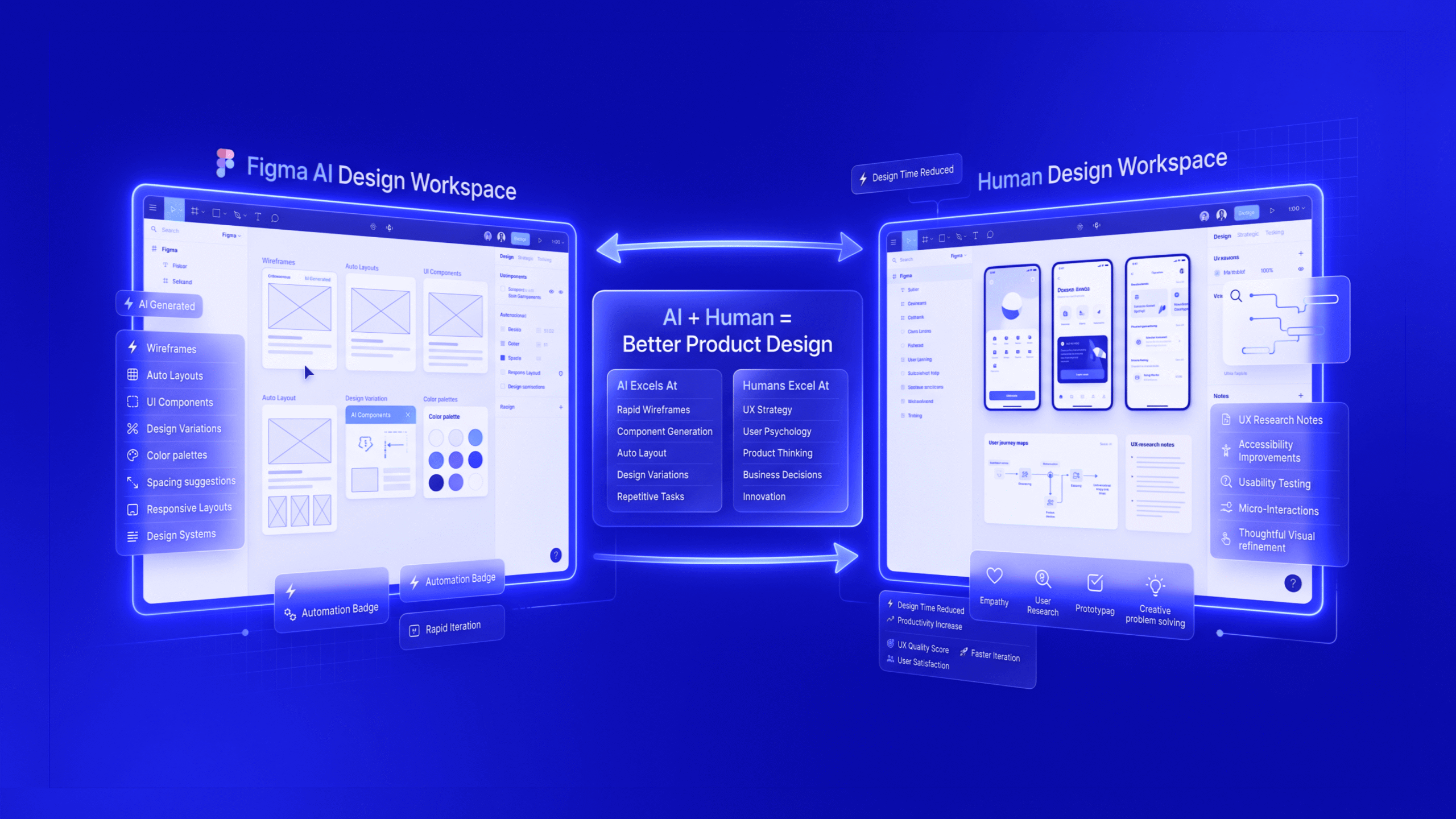
Figma is still one of the most important tools in the UI/UX design workflow. In 2026, it is no longer only a screen design tool. It now includes AI features for design productivity, visual search, layer cleanup, text help, asset discovery, image editing and prototype exploration.
What it does
Figma AI helps with:
Renaming messy layers
Generating or refining text
Finding visual assets faster
Cleaning up design files
Editing images and backgrounds
Exploring prototype and interaction directions
Working inside the same file where designers already design
How it helps a UI/UX designer
Figma AI is most useful for small tasks that usually break the design flow. If a file has messy layers, AI layer renaming can save time. If a prototype needs quick placeholder copy, the text tools help. If a designer needs to explore interaction directions, AI can support faster experimentation before the final experience is refined manually.
For serious UI UX design work, designers still need to make the actual experience decisions themselves. But for file cleanup, first drafts, prototypes and repetitive tasks, Figma AI is useful.
Cost
Figma has a free Starter plan. The Professional full seat is listed at $16/month when billed annually. AI credits are included depending on the plan and seat type.
Best for
UI designers, UX designers, product designers, design system teams and teams already using Figma every day.
2. ChatGPT
ChatGPT is one of the most useful AI tools for UX thinking, content, research synthesis and product communication. It is not a UI design tool, but it can support many thinking-heavy parts of the design process.
What it does
ChatGPT helps with:
UX microcopy
Onboarding copy
Error messages
Empty states
User interview questions
Research summaries
UX audit reports
Product thinking frameworks
Explaining design decisions clearly
How it helps a UI/UX designer
ChatGPT is useful when the challenge is thinking, writing or structuring information.
For example, if a team is designing a fintech onboarding flow, ChatGPT can help list possible user doubts and concerns. If a team is redesigning a dashboard, it can help group metrics based on user decision-making. If there are raw research notes, it can help identify patterns, repeated pain points and possible design implications.
It is also useful for UX research preparation, UX writing, UX audit reports and content structure.
Cost
ChatGPT has a free plan. The current ChatGPT pricing page lists Free, Go, Plus, Pro, Business and Enterprise plans. Pricing may vary by region and plan.
Best for
UX writing, product thinking, research synthesis, audit reports, content structure and explaining design work.
3. Claude
Claude is very useful when the work involves long documents, messy notes or deep thinking. It is especially helpful for UX audit writing, product strategy, research synthesis and long-form documentation.
What it does
Claude helps with:
Summarizing long research notes
Structuring UX audit reports
Product strategy documents
UX writing
Grouping user interview findings
Feature prioritization
Turning messy inputs into clear explanations
How it helps a UI/UX designer
Claude is useful when a team has a lot of information and needs to turn it into something clear.
For example, if there are notes from multiple user interviews, Claude can help group them into themes. If there is a messy audit document, it can help structure issues by severity, user impact and recommended fixes. If a designer needs to explain design decisions to a founder or developer, Claude can help turn thinking into clear language.
It is not a final UI generation tool. It is better for thinking, structure, research, documentation and communication.
Cost
Claude has a free plan. Claude Pro is listed at $17/month with annual billing or $20/month when billed monthly.
Best for
Research synthesis, UX audit documentation, product strategy, long-form UX writing and clear design explanations.
4. Perplexity
Perplexity is useful when designers need research with sources. For UI/UX designers, this is helpful for competitor research, market research, industry understanding, trend checks and early discovery.
What it does
Perplexity helps with:
Finding current information with sources
Summarizing industry research
Competitor research
Finding examples and references
Understanding unfamiliar industries
UX and product trend research
How it helps a UI/UX designer
Before designing for an unfamiliar industry, designers need to understand the space. For example, if the product is in logistics, insurance, healthcare, education or finance, the design team needs to know how users think, what problems are common and what competitors are doing.
Perplexity is useful because it gives sources, which makes it better for research than relying only on memory or unsourced AI summaries.
Cost
Perplexity has free and paid plans. Pricing can change by plan and market, so it is best to check the current Perplexity pricing page before buying.
Best for
Competitor research, market research, trend research and fact-checking design assumptions.
5. Uizard
Uizard is one of the more direct AI UI design tools. It is useful for generating quick wireframes, mockups and visual interface directions from prompts. It can also turn screenshots and hand-drawn wireframes into editable designs.
What it does
Uizard helps with:
Generating UI from text prompts
Creating wireframes
Turning screenshots into editable mockups
Turning hand-drawn sketches into digital designs
Creating quick prototypes
Helping non-designers visualize product ideas
How it helps a UI/UX designer
Uizard is useful when a team needs quick visual directions. It is not where polished product UI should be finalized, but it is helpful in the early stage.
For example, if a founder says, “We need a basic dashboard for fitness coaches,” Uizard can generate a few rough screen directions quickly. Then a designer can take the useful parts into Figma and design properly.
It is also helpful for early MVP design discussions, where the team needs to see the idea before investing in full design.
Cost
Uizard has a free plan. Uizard Pro is listed at $12/month when billed annually. Business is listed at $39/month.
Best for
Fast wireframes, rough mockups, startup MVP concepts and early product visualization.
6. Relume
Relume is useful for website UX work. It helps designers create sitemaps, wireframes and style guide directions for websites faster.
What it does
Relume helps with:
Generating website sitemaps
Turning sitemaps into wireframes
AI website copy drafts
Style guide directions
Figma and Webflow workflows
Planning marketing websites and landing pages
How it helps a UI/UX designer
Relume fits naturally into a website design workflow. If a team needs to plan a service website, SaaS website or landing page, Relume can generate the first sitemap and wireframe structure.
The final content, hierarchy, journey and interface still need design thinking. But Relume saves time at the blank-page stage.
Relume has a free plan and paid plans. Pricing depends on usage, project needs and team requirements. You can check the current plans on the Relume pricing page.
Best for
Website UX, sitemaps, wireframes, landing pages, service websites and SaaS websites.
7. Framer AI
Framer is useful for designers who want to move from idea to live website quickly. It supports AI-assisted website creation, layouts, site copy, publishing and editing inside a website-building workflow.
What it does
Framer helps with:
Building websites from prompts
Creating landing pages
Generating page sections and layouts
AI site copy
Web publishing
Helping designers ship websites without depending on developers for every small change
How it helps a UI/UX designer
Framer works well when the output is a website, landing page, portfolio or campaign page. It is not the first choice for complex dashboards, but it is useful for shipping websites faster.
A designer can use Figma for the visual direction and Framer to build the live version. A team can also use Framer AI to get a rough website structure and then manually refine each section.
Cost
Framer has a free plan and paid site plans. Its pricing page shows plan-based pricing and AI credits depending on the selected plan.
v0 by Vercel is useful when a team wants to turn a prompt into working UI code. It is more developer-focused than designer-focused, but it can still help UI/UX designers explore functional interface ideas.
What it does
v0 helps with:
Generating UI code from prompts
Creating React-style components
Building dashboards and forms
Landing page sections
Coded prototypes
Bridging design and development
How it helps a UI/UX designer
v0 should not replace Figma. It is more useful when a designer needs to show how an interface could behave, or when a team wants to quickly explore a functional version of a dashboard, calculator, form or web app screen.
It is especially useful when working with developers because the output is closer to code than a static mockup. A designer can prompt a rough interface, review what works and bring better structure back into the design process.
Cost
v0 pricing currently lists Team at $30/user/month and Business at $100/user/month. It also has Free and Enterprise plans.
Best for
Functional UI prototypes, coded components, dashboards and design-to-development exploration.
9. Miro AI
Miro AI is useful in the early UX stage. It helps with brainstorming, workshops, journey maps, affinity mapping, prioritization, user flows and product strategy sessions.
What it does
Miro AI helps with:
Brainstorming
Summarizing sticky notes
Grouping ideas
Creating diagrams and maps
Workshops
User flows and journey mapping
How it helps a UI/UX designer
Miro AI is helpful before the interface design stage.
If a team runs a discovery workshop, Miro can collect ideas, group notes, summarize findings and convert scattered thoughts into structured flows. It is also useful for client workshops because everyone can collaborate visually.
AI is most helpful after the messy part of a workshop, when there are too many notes and someone needs to turn them into themes.
Cost
Miro has a free plan. Miro Starter is listed at $8/member/month when billed yearly.
Best for
Discovery workshops, UX mapping, brainstorming, journey maps and collaboration.
10. Lyssna
Lyssna is a user research and usability testing platform. It is useful for quick tests like first-click testing, five-second testing, preference testing, prototype testing, card sorting, tree testing and surveys.
What it does
Lyssna helps with:
First-click tests
Five-second tests
Preference testing
Prototype testing
Card sorting
Tree testing
AI follow-up questions
AI summaries on supported plans
How it helps a UI/UX designer
Lyssna is useful when a design team needs quick validation.
For example, if there are two homepage hero designs, Lyssna can help test which one users understand faster. If a team is unsure about navigation labels, it can run a tree test. If a team wants to know whether users notice a CTA, it can run a first-click test.
This is helpful because it moves conversations away from “this looks nice” and closer to “users understood this better.”
Cost
Lyssna has a free plan. Lyssna Growth is listed at $165/month on annual billing.
Best for
Quick UX validation, preference testing, first-click testing, prototype testing and information architecture testing.
11. Maze
Maze is a product research platform for teams that need to test prototypes, validate concepts, run surveys and turn research into reports.
What it does
Maze helps with:
Prototype testing
Concept validation studies
Surveys
Live website testing
Card sorting
AI-supported product research workflows
Automated research reports
How it helps a UI/UX designer
Maze is useful when research needs to be more structured. It works well for product teams that need to test prototypes, collect user behavior and share reports with stakeholders.
For designers, it helps prove whether a flow works before development. Instead of relying only on internal opinions, teams can collect user behavior and use that to guide improvements.
Cost
Maze pricing is currently demo/contact-sales based, so teams need to request pricing based on their research needs.
Best for
Product teams, UX researchers, prototype testing, concept validation and structured research programs.
12. Contentsquare and Hotjar
Hotjar is now part of the broader Contentsquare ecosystem. For UI/UX designers, this matters because the familiar workflow of heatmaps, recordings, surveys and feedback is now connected to a wider digital experience analytics platform.
What it does
Contentsquare and Hotjar help with:
Heatmaps
Session recordings
Surveys
Funnels
Friction in user journeys
Error and performance monitoring on selected plans
AI-supported analysis
How it helps a UI/UX designer
This is one of the most useful tool categories after a website or product goes live.
If users are not clicking the CTA, heatmaps and recordings can show what they actually do. If users abandon a form, funnels can show where. If a page looks good but does not convert, surveys can help ask users what stopped them.
For a UX audit, behavior analytics tools are very helpful because they show real user behavior, not just opinions.
Cost
Contentsquare pricing includes a free plan. Its Hotjar page mentions that the free plan captures 200,000 sessions per month. Paid pricing depends on plan, usage and business needs.
Omneky is an AI-powered ad generator and creative platform for image, video and omnichannel advertising campaigns. It helps teams generate ad creatives, launch campaigns across platforms and understand creative performance from one place.
This is not a traditional UI design tool like Figma or a wireframing tool like Uizard. But it is still useful for UI/UX designers, especially when the work touches campaign UX, landing pages, ad-to-page consistency, creative testing, conversion design or AI product UX.
What it does
Omneky helps with:
AI ad creative generation
Image, video and UGC-style ad creation
Ad copy and creative variation generation
Brand rule management
Campaign launching across platforms
Omnichannel creative insights
Creative performance comparison
AI ad scoring and recommendations on selected plans
Predictive analytics and performance dashboards
How it helps a UI/UX designer
Omneky helps UI/UX designers when the design work is connected to marketing performance, user acquisition or conversion journeys.
For example, a landing page does not exist alone. A user may come from a Meta ad, Google ad, TikTok ad or LinkedIn campaign. If the ad message and landing page experience do not match, the user journey feels broken. Omneky can help teams test multiple creative directions, understand which hooks and messages work, and use those learnings to improve campaign landing pages, hero sections, CTA copy and conversion flows.
It also helps designers understand how AI-powered marketing products should be designed. In TheFinch Design’s Omneky UI/UX case study, the product needed to support AI ad generation, campaign deployment and performance monitoring in one platform. The UX challenge was not only about making screens look good. It was about simplifying a complex journey from creative generation to campaign launch and analytics.
That makes Omneky useful in two ways:
As a tool for creative testing, campaign UX and performance insights
As a reference for designing complex AI products where users need clarity, control and trust
For teams designing AI tools, dashboards or marketing platforms, Omneky is a strong example of why AI product UX design matters.
Campaign UX, AI ad creative generation, ad-to-landing-page alignment, performance marketing insights, creative testing, conversion-focused UX and AI product UX references.
14. Canva AI
Canva AI is not a core UI/UX design tool, but it is useful for supporting design work. It is helpful for presentations, social posts, pitch decks, quick visuals, simple mockups and design communication.
What it does
Canva AI helps with:
Presentations
Social media visuals
Image and design directions
Quick content visuals
AI writing and editing tools
Simple marketing graphics
How it helps a UI/UX designer
Canva is useful when design work needs to be explained or presented.
For example, if a team needs a deck explaining audit findings, Canva can help create presentation layouts quickly. If a company needs social media graphics for a UI/UX topic, Canva can help generate layouts. If a designer needs quick visual placeholders, Canva AI can help.
It should not be used for final product UI. But for communication, content and presentations, it is helpful.
Cost
Canva has free and paid plans. Canva pricing mentions AI usage limits that vary by plan, including separate limits for Standard, Premium and Ultra AI tools.
Best for
Presentations, pitch decks, social media content, marketing visuals and design communication.
15. Adobe Firefly
Adobe Firefly is useful for image editing, generative fill, creative exploration, moodboards, visual assets and marketing graphics. Designers already using Photoshop, Illustrator or Adobe Express will find Firefly useful inside the Adobe workflow.
What it does
Adobe Firefly helps with:
Image generation
Generative Fill
Image extension and editing
Visual concepts
Moodboards
Marketing visuals
Creative Cloud workflows
How it helps a UI/UX designer
Adobe Firefly is useful when the design work needs strong visuals. For example, landing page visuals, hero image directions, moodboards, presentation graphics and marketing assets.
For product UI, Adobe AI should be used carefully. It is better for visual support than for designing the actual user experience. Still, when designers need to create visual directions quickly, it helps.
Cost
Adobe Firefly Pro in India is listed at ₹1,596.54/month including GST with 4,000 monthly generative credits.
Attention Insight is useful when designers want to predict where users may look before a design goes live. It uses AI attention heatmaps to estimate visual attention without running a full eye-tracking study.
What it does
Attention Insight helps with:
AI attention heatmaps
Visual hierarchy checks
Predicting where users may look
Landing page reviews
Testing ad creatives and website sections
Pre-launch attention checks
How it helps a UI/UX designer
This is useful before launching a landing page or homepage. If the CTA is not getting enough visual attention, or if the user’s eyes are pulled to the wrong part of the screen, the layout can be improved before publishing.
It does not replace usability testing, but it can be a good early check for visual hierarchy.
Cost
Attention Insight offers a 14-day free trial. Paid plans vary based on plan and usage.
AI tools have brought the revolution in the UX design industry with its streamlined pattern of working. Even designing the user interface has gained pace. It has automated repetitive tasks to save time and invest in the core objective UX design to increase productivity. With more time to focus on user behavioral patterns you can make the design more user centered.
It has led us to efficient secondary research to get data driven insights about users. These AI tools can even analyze the user behavioral patterns allowing you to focus on more important aspects of the design. Some tools are made keeping the idea of collaboration in mind. Such tools can facilitate real-time collaboration between designers and brands. Along with all these features, AI tools also help you in writing and presenting tasks.
A practical AI workflow for UI UX designers
A practical AI workflow does not start with generating screens. It starts with understanding the problem.
For industry and competitor research, designers can use Perplexity. For research synthesis, UX writing and design explanation, ChatGPT or Claude can help. For website planning, Relume can speed up sitemap and wireframe creation. For UI design, Figma remains the main workspace. For quick rough screens, Uizard can help. For websites, Framer can help move from design direction to live pages faster. For coded prototypes, v0 can support design-to-development exploration.
For validation, Lyssna or Maze can help test flows and concepts. After launch, Hotjar or Contentsquare can show real user behavior. For campaign experience, Omneky can help teams understand which messages, visuals and ad creatives are working before improving the landing page experience. For supporting visuals and presentations, Canva and Adobe Firefly can help.
That is the real value of AI in UI/UX design. It connects the workflow from research to design to testing to improvement.
What AI still cannot do well
AI tools are useful, but they still have limits.
AI can generate a screen, but it does not always understand the business model. It can write UX copy, but it does not always know the user’s emotional state. It can create a wireframe, but it may not understand priority, hierarchy or real product constraints. It can summarize research, but it can miss nuance if the input is weak.
The designer’s job is still to make decisions.
A good designer asks:
Is this flow actually useful?
Does this solve the user’s problem?
Is the hierarchy clear?
Does this support the business goal?
Is the copy honest and helpful?
Can users complete the task without confusion?
Can developers build this properly?
Will this scale?
AI can support those decisions, but it should not replace them.
Final thoughts
The best AI tools for UI/UX designers in 2026 are not the tools that promise to “design everything for you.” The best tools are the ones that help designers think faster, test faster, explain better and reduce repetitive work.
AI is most useful in four places:
Starting from a blank page
Cleaning up messy research or content
Testing more ideas in less time
Explaining design decisions clearly
The designers who will benefit most from AI are not the ones who blindly generate screens. They are the ones who know UI UX design fundamentals well enough to judge what AI creates.
AI can speed up the process.
But the designer still owns the thinking.
Need UI UX design support for your product?
AI tools can speed up parts of the design workflow, but the right product experience still needs clear thinking, user understanding and strong design execution.
AI for UI/UX design means integrating artificial intelligence and machine learning technologies into UI & UX design processes. AI automates various design aspects, such as creating wireframes, design elements, etc.
How to use AI In UI/UX Design?
Designers can use AI in UI/UX design in many ways. AI helps automate predictive analytics, create and enhance visuals and design elements, the natural language for chatbots, etc.
How does AI benefit UI/UX Design?
AI for UX design has many benefits: automated repetitive tasks, improved UX, faster design iterations, data-driven decisions, etc.
What are AI design tools?
AI design tools are software platforms that use artificial intelligence to help with design-related tasks. These tools can generate UI ideas, create wireframes, summarize research, write UX copy, build prototypes, generate visuals, analyze user behavior or support design-to-code workflows. Examples include Figma AI, ChatGPT, Claude, Uizard, Relume, Framer, v0, Miro AI, Lyssna, Maze, Omneky, Canva AI and Adobe Firefly.
What is the best AI tool for UI UX designers?
There is no single best AI tool for every UI UX designer. Figma AI is useful for design work inside Figma, ChatGPT and Claude are useful for UX writing and research synthesis, Uizard helps with quick wireframes, Relume helps with website planning, v0 helps with coded UI prototypes, and Lyssna or Maze help with testing. The best tool depends on the task.
Can AI replace UX designers?
AI can support UX designers, but it cannot fully replace them. AI can generate ideas, summarize research, draft copy and create rough screens, but it does not truly understand users, business goals, product context, accessibility needs or long-term design decisions the way a skilled UX designer does. Designers still need to guide the process, judge the output and make the final experience decisions.
Ravi Talajiya
CEO of TheFinch
With over a decade of experience in digital design and business strategy, Ravi leads TheFinch with a vision to bridge creativity and purpose. His passion lies in helping brands scale through design thinking, innovation, and a deep understanding of user behavior.
Would you like to Listen?
Share this blog
Got the vision? We’ve got the expertise. Let’s create together.